




The economic theatre has widened faster than the military one.
On the fifth day of the United States-Israel war against Iran, the conflict stands in a position neither side may have fully anticipated when the first strikes were launched on Feb 28.
The US and Israel may have achieved clear tactical air dominance over large parts of Iran with fixed air defence networks having been degraded, leadership having been struck at the highest level, and naval assets mostly at pier have been largely damaged. Yet the strategic picture remains unsettled, and in some respects, increasingly complicated.
The opening hours of the war were decisive in military terms. Stealth platforms penetrated whatever air defences Iran possessed after last year’s 12-day war, followed by bomber waves which suppressed what were once key elements of the integrated air defence system.

US-Israeli targets were not symbolic but structural, including leadership nodes, fixed military infrastructure, naval platforms, and border posts. The assassination of Iranian Supreme Leader Ayatollah Seyyed Ali Khamenei was intended to decapitate the system and induce dislocation at the apex of command.

Decapitation occurred, but dislocation did not.
Iran’s governance and warfighting model, long seen as decentralised and multi-layered, has demonstrated redundancy, especially after the recent changes and what Iranian officials call the “Decentralised Mosaic Defence” (DMD) strategy, under which authority has diffused across dispersed nodes, whereas operational continuity has been preserved. Thanks to the adapted military strategy, five days on, there is no indication of systemic collapse despite the massive decapitation blows suffered by Iran and, militarily speaking, a progressive degradation of fixed systems.
Iranian S300 and Bavar batteries have lost most of their fixed radars and command centres, allowing US and Israeli aircraft to operate with relative freedom in Iranian airspace. Precision munitions have been released near Tehran, and at the same time, surface naval losses have been significant, with eight vessels reportedly severely damaged, many while pierside, including the Fateh submarine.
The torpedoing of the Iranian frigate IRIS Dena by a US submarine in international waters off Sri Lanka’s southern coast on Wednesday has dramatically extended the geographic scope of the war, bringing the US-Iran conflict directly into South Asian maritime space for the first time. This strike, occurring roughly 75 km from Galle in waters far removed from the Persian Gulf, signals that the coalition is now willing to pursue Iranian naval assets globally.
Despite all these constraints and setbacks, the Iranian response has not been structured around symmetrical retaliation. Instead, it has been that of calibrated saturation. In four days, 871 missiles and 1,126 drones had been directed at Gulf targets. Though interception rates in the United Arab Emirates (UAE) and Qatar remained high, exceeding 90 per cent, the volume has produced a cumulative effect. On the other side, interceptor stocks of Gulf states are depleting fast and may run out in days if not immediately replenished.
Meanwhile, seven communications and radar systems — including two AN/GSC-52B SATCOM terminals at the US Navy’s 5th Fleet HQ in Bahrain, the AN FPS 132 early warning radar at Al Udeid, the facility at Camp Arifjan in Kuwait, and ancillary facilities linked satellite communications infrastructure at Ali Al Salem Air Base in Kuwait — have been destroyed leading to degradation of US C4ISR (Command, Control, Communications, Computers, Intelligence, Surveillance, and Reconnaissance) capabilities across key regional bases, which could temporarily blind or severely hamper real-time missile defence coordination, long-distance communications, and theatre wide situational awareness. Moreover, approximately a dozen US personnel have been killed and three F-15E aircraft have been lost, which the Americans, probably as an afterthought, blamed on friendly fire.
While these achievements could have been an advantage, Iranian missile tempo has moderated over the past 48 hours, not due to depletion but for conservation and other operational constraints. Tehran, therefore, appears to be adjusting fire rates to sustain pressure while forcing adversaries to expend high-value interceptors at disproportionate cost. This is attrition.
The economic theatre has widened faster than the military one. The Strait of Hormuz, though not mined in a physical sense, has been effectively disrupted due to Iranian declarations, selective tanker incidents and swift insurance withdrawals, leading to commercial paralysis and spikes in oil and liquefied natural gas (LNG) prices. Supply chains linked to QatarEnergy and Saudi exports are under stress. In this backdrop, the insurance schemes and naval escorts announced by US President Donald Trump represent emergency stabilisation measures rather than restored normalcy.
Combined daily economic and operational costs across belligerents and affected states are estimated in the multi-billion-dollar range. It may be very bad news for others, but it aligns with Tehran’s doctrinal emphasis on cost imposition and political exhaustion.
Activation of the network of allies by Iran has followed a deliberate sequence. Hezbollah, which, after the martyrdom of Hassan Nasrallah, had been relatively quieter, has conducted rocket and drone attacks toward Israeli targets, staging a major comeback, whereas Iraqi factions have reported multiple daily actions. Houthis have on their part issued threats toward Bab el Mandeb and Saudi facilities. Strikes on US diplomatic sites in Gulf states have also occurred. But still, it can be said that no simultaneous all-front barrage has been launched, implying controlled escalation without abandonment of thresholds.
The original US-Israel aims were expansive. Missile and naval elimination, proxy neutralisation, nuclear denial, and regime fracture were all articulated in varying formulations. After five days, these objectives are only partially realised. Iranian military infrastructure was degraded, whereas allied networks remained functional and regime fracture had not materialised.
Political messaging from the US also contributed to uncertainty. Initial justification of the attacks centred on pre-emption against an imminent Iranian strike, a claim that was not supported by US intelligence assessments and contradicted by Pentagon briefings. The rationale then shifted toward elimination of missile and naval threats, and subsequently to broader regime pressure, including openness to arming internal militias and Kurdish or Baloch groups. This evolution revealed that Trump entered the conflict with unclear goals and exit criteria.
The moral dimension has deepened the challenge, further delegitimising the already illegitimate war. The first wave of strikes inflicted significant civilian casualties, and more than 160 schoolgirls were martyred on the first day. In subsequent days, Gandhi Hospital in Tehran was struck and portions of Golestan Palace, recognised by Unesco as a World Heritage Site, were also destroyed. Persian language commentary and regional Arabic analysis have framed these attacks as disproportionate and strategically reckless, helping Tehran’s narrative of existential defence gain traction.
A new layer in this conflict is emerging along Iran’s western border. Multiple strikes have targeted frontier patrol and regular army units. Intelligence assessments suggest that the attacks intend to weaken perimeter control and create openings for Iraq-based Kurdish armed insurgents who are being armed by the Central Intelligence Agency (CIA) to stimulate an internal uprising. Trump has engaged with the Democratic Party of Iranian Kurdistan leader, Mustafa Hijri, as another Kurdish insurgent group, the Party of Free Life of Kurdistan, remains designated under US Treasury restrictions. Baloch militant groups have reorganised under a national opposition banner, with weapons allegedly smuggled since 2025.
This surrogate strategy introduces unpredictable variables and lacks unified command and control over armed groups. The Syrian experience offers cautionary lessons, but in Iran’s case, its size, ethnic diversity and entrenched national identity may generate consolidation rather than fragmentation. Turkish sensitivity over Kurdish precedents, Pakistani concerns over Baloch linkages, and other regional dynamics could produce regional alignment against perceived territorial threats.
Inside Iran, succession mechanisms are proceeding. The Assembly of Experts is expected to formalise leadership transition despite the bombing of its offices in Qom on Tuesday and the Israeli threat of targeting the new leadership.
Three scenarios dominate current assessments. The most probable is prolonged high intensity attrition with regionalisation, where missile exchanges, maritime disruption and phased proxy activity continue. A second possibility involves controlled escalation through peripheral fronts without full widening. A third, less likely but significant, is internal consolidation, reinforcing regime cohesion.
Key variables include interceptor sustainability, economic tolerance in Gulf states, and political endurance in Washington and allied capitals.
Five days in, the arithmetic of the conflict is becoming clearer with the US-Israel coalition commanding the skies and having degraded visible assets. Iran, meanwhile, has preserved dispersed capabilities, imposed asymmetric costs and shifted the war into a test of stamina. In this phase, endurance may weigh more heavily than shock.
At the same time, diplomatic space is tightening. Mediation attempts via Oman and Qatar have been rejected by Tehran, which presents the conflict as a test of endurance to be concluded on its own terms.
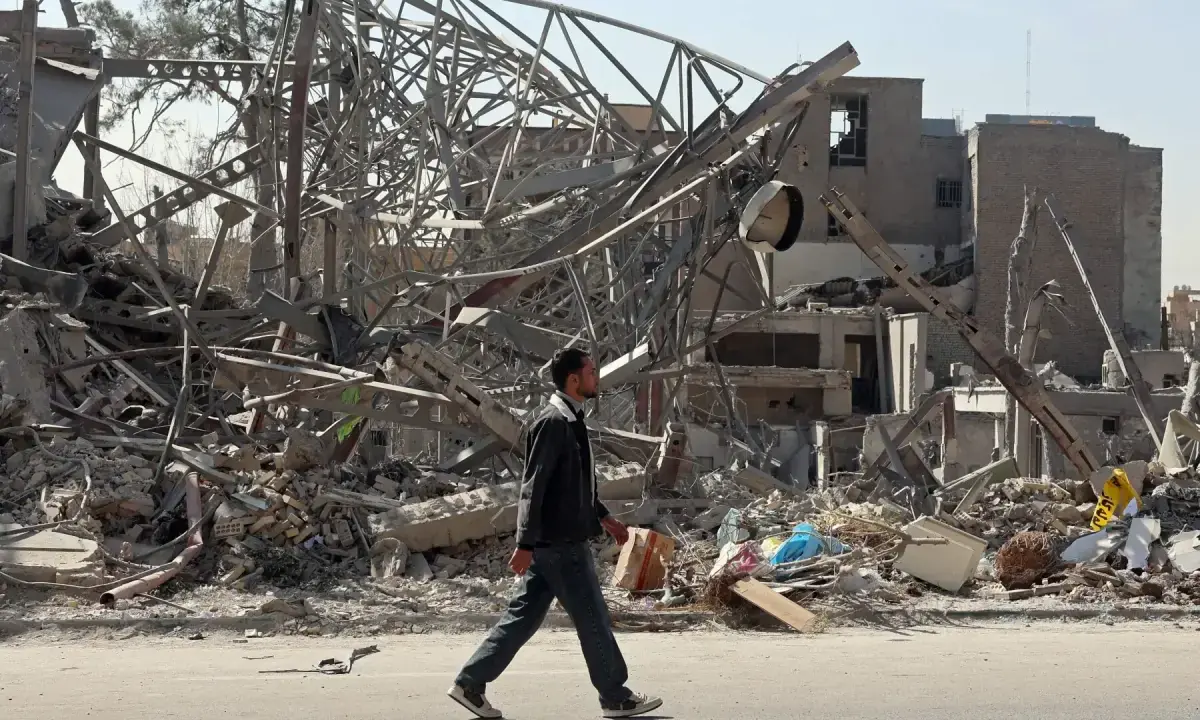
Header image: A man walks past destroyed buildings following airstrikes in central Tehran on March 4, 2026. — AFP

