




Carney says Washington did not consult allies, including Canada, before launching strikes against Tehran
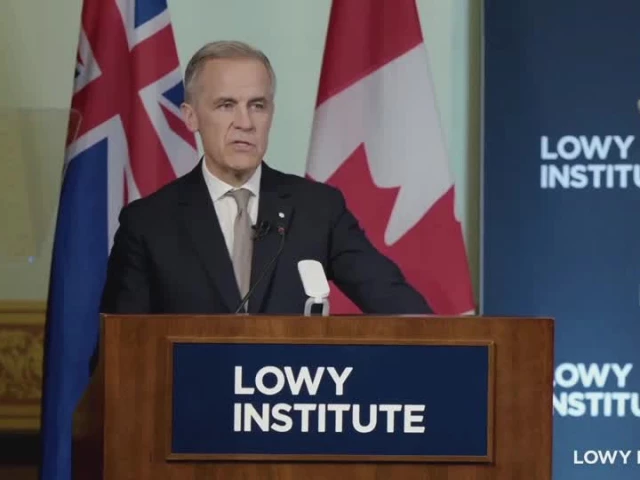
Prime Minister Carney speaking at the Lowy Institute think tank in Sydney on March 4, 2026. PHOTO: SCREENGRAB
TORONTO:

Canadian Prime Minister Mark Carney said on Wednesday that the ongoing conflict in the Middle East was a “failure” of the international order, and the United States had not consulted its allies before striking Iran.

US and Israeli forces launched strikes against Iran on Saturday after negotiations over Tehran’s nuclear programme stalled.
The war has since spread beyond Iran’s borders, with Iranian attacks hitting Gulf states including Bahrain, the United Arab Emirates (UAE) and Qatar, as well as US embassies in Saudi Arabia and Kuwait, prompting Washington to close diplomatic missions across the region.
Read: Iran war enters fourth day in ‘smoke and blood’ as global markets slide
“The current conflict is another example of the failure of the international order, despite decades of UN Security Council resolutions, the work of the International Atomic Energy Agency in a succession of sanctions and diplomatic frameworks,” Carney said during a visit to Australia in a speech at the Lowy Institute think tank in Sydney.
“Iran’s nuclear threat remains, and now the United States and Israel have acted without engaging the UN or consulting with allies, including Canada.”
De-escalation of hostilities needed
Earlier, Carney called for calm in the Middle East and said all countries engaged in hostilities, including the US and Israel, must respect international rules of engagement. “Canada calls for a rapid de-escalation of hostilities and is prepared to assist in achieving this goal,” Carney told reporters.
When asked about previous comments he made supporting the UN Charter’s prohibition of the use of force, Carney said “it appears that these actions are inconsistent with international law,” but said it was up to the US and Israel to make the case whether they were consistent with international law.
“It’s for others more expert than me … to make that determination,” he said.
Read More: Americans stranded in Middle East told not to rely on US evacuation helpline
Carney said Canada was not informed in advance of the strikes and was not asked to participate. “We would not have been in a position … to take a judgement that met our standards if we had been asked to participate,” Carney said.
After the strikes began at the weekend, Carney said Canada supported the US “acting to prevent Iran from obtaining a nuclear weapon and to prevent its regime from further threatening international peace and security.”
March of the middle powers
Carney is on a multi-leg trip across the Asia-Pacific region also taking in Japan and India, with his stop in Australia aimed at bolstering relations between the two so-called “middle powers”.
“Canada is focused on building a dense web of connections, ad hoc coalitions that work issue by issue, with partners that share enough common ground on those issues to act together,” Carney said on Wednesday.
Also Read: Iran hits CIA site in Riyadh as US seeks to arm Kurdish forces against Tehran
“In contrast, great powers can afford to go it alone. They have the market size, the military capacity to leverage, to dictate terms. Middle powers like Canada do not.”
Australia and Canada are expected to deepen cooperation in areas such as defence and maritime security, critical minerals, trade and artificial intelligence, Carney’s office said ahead of the visit.

