



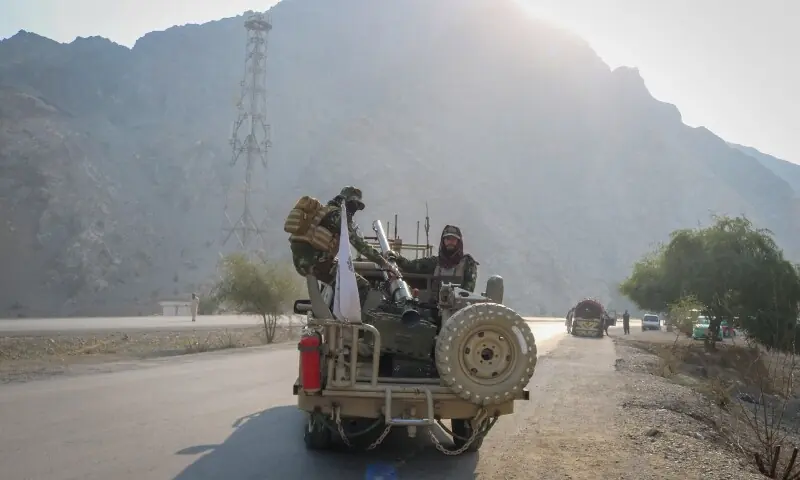

When states escalate, they are usually clear about their capacity and objectives. The Afghan Taliban, however, appeared to abandon that principle at the Pakistan-Afghanistan border last night, triggering an intense military confrontation — including airstrikes and artillery exchanges — across the Durand Line as well as deep into Afghan territory.
The immediate backdrop of these tensions is not new. Islamabad has for years maintained that the Tehreek-i-Taliban Pakistan (TTP), a Pakistani terrorist group affiliated with the Afghan Taliban, operated from Afghan soil because of the official patronage it enjoys there.
Only hours before the latest crisis erupted, Foreign Office Spokesperson Tahir Andrabi plainly stated that Pakistan’s quarrel was not with the Afghan people but with terrorist safe havens that threaten Pakistani lives.
That was the political setting; it emphasised the need for patient engagement and discreet signalling. The Afghan Taliban, however, chose to announce what it described as “large-scale offensive operations” along multiple border towns, in a language that was both public and declaratory.
A miscalculation by Kabul?
There may have been reasons why the Taliban regime opted for that course. Firstly, the border remains, in the Afghan political imagination, a colonial imposition.

Secondly, the Taliban leadership sought to signal that it would not acquiesce to cross-border action, especially after Islamabad’s February 22 strikes against terrorist sanctuaries on the Afghan territory, and frame the move as a defence of territorial integrity.
However misplaced that logic may be, given that the initial breach of Afghan sovereignty occurred when terrorist groups were allowed sanctuary there, the public mobilisation still serves a domestic purpose as it projects resolve to constituencies that expect the regime to defend Afghan soil.
Another calculation may have been that the escalation would remain contained. There is precedent. In October last year, after intense clashes, back channels and Qatari-Turkiye mediation produced a ceasefire. Though the understanding was uneasy, it worked. Kabul may have assumed that another round of tit-for-tat exchanges would similarly be cooled by intermediaries once tempers had flared.
But that assumption proved risky.
Pakistan responded not with ambiguity but with a named operation — “Ghazab lil-Haq” or “Righteous Fury” — and carried out airstrikes that reached deep into Afghan territory, including targets around Kabul, Kandahar, Paktia and Nangarhar. Meanwhile, Defence Minister Khawaja Asif spoke in unusually blunt terms, saying patience had reached its limit and characterised the situation as open war.
Pakistan’s logic was clear. Terrorism inside the country surged after the Taliban seized control of Afghanistan in August 2021, and even more sharply over the past year and a half. As a result, there is zero tolerance in Islamabad for threats perceived to be emanating from Afghan soil. In that context, a declared offensive by Afghan forces against Pakistani positions was unlikely to go unanswered because any perception of restraint in the face of a televised provocation would have carried both morale and political costs.
Resultantly, there was a spiral which neither side could easily control. Casualty figures differ widely, with claims and counterclaims dominating the official messaging.
Beyond the battlefield
But far from the borders and the war zones lies the question of strategic arithmetic. The Taliban’s strengths are rooted in unconventional and guerrilla-style warfare, whereas Pakistan’s advantages lie in its conventional force structure, air power and deterrent capability.
It implies that a head-on military contest would therefore never favour Kabul. That is where the Taliban appear to have misstepped; by shifting the theatre from deniable sub-conventional activity to overt interstate confrontation, they exposed themselves to costs they were ill-equipped to absorb.
Yet, force alone will not settle the underlying grievance. Islamabad’s central complaint is neither territorial expansion nor ideological contest; rather, it is the presence of terrorists who strike inside Pakistan while operating from Afghan soil.
The concern is not merely rhetorical. Year after year, United Nations Security Council monitoring reports have documented the continued presence and activity of the TTP in Afghanistan and described linkages between the group and the Taliban regime. The international record, therefore, is also clear.
Now that the issue is terrorist sanctuaries, the remedy cannot be spectacle. It has to be structural.
First, Kabul will need to address, credibly and verifiably, the question of armed groups operating from its soil; mere denials will not suffice.
Secondly, regional stakeholders with access to both capitals should be re-engaged at senior levels.Qatar and Saudi Arabia facilitated de-escalation in October last year. They are trying again. Others with leverage, including China and Turkey, can play quiet roles. Russia and Iran, too, have offered their good offices.
Third, both sides must reduce the temperature of public rhetoric since declarations of open war may satisfy domestic audiences but would complicate compromise, which has to ultimately happen.
There is no gainsaying the fact that there are no simple exits in such scenarios. Escalation acquires its own momentum, and each strike invites a reply, narrowing the space for discretion. As a result, economies suffer, border communities absorb the shock, and terrorist groups thrive.
For durable security, Islamabad must convert its battlefield advantage into diplomatic leverage rather than allow it to harden into permanent hostility. Meanwhile, this conflict must drive home to Kabul that a policy of hosting terrorist sanctuaries carries strategic costs.
If that lesson is not absorbed, what is now a crisis will solidify into a recurring pattern, and hostility will become entrenched.
Header image: Taliban fighters carry a rocket launcher in a vehicle, following exchanges of fire between Pakistan and Afghanistan forces, near Torkham border in Afghanistan, February 27, 2026. — Reuters


