




Record travel, packed cinemas and a retail surge signal rising confidence in the world’s second-largest economy
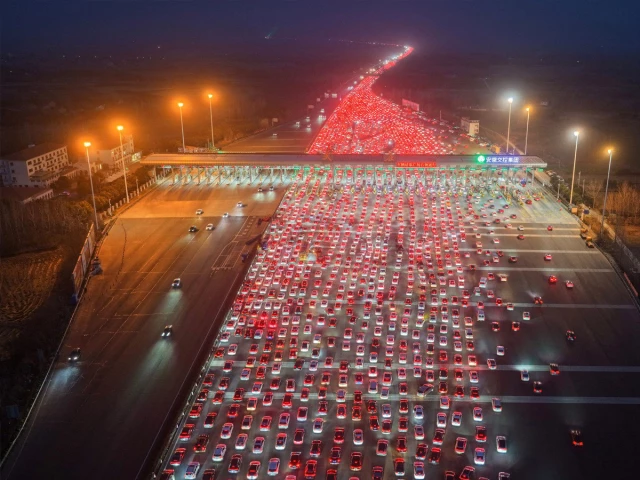
Drivers merge onto expressway lanes after passing through the Wuzhuang toll station in Chuzhou, eastern China’s Anhui Province on February 22, 2026, at the end of the Spring Festival holiday marking the Year of the Horse. Photo: AFP
BEIJING:

China’s record-breaking nine-day Spring Festival holiday has unleashed a powerful wave of consumer activity, delivering a broad-based boost to travel, retail, dining and entertainment and offering policymakers an encouraging early-year signal for the world’s second-largest economy, according to the Chinese media.

By extending the traditional seven-day Lunar New Year break to nine consecutive days in 2026, authorities effectively created a “segmented holiday” model. Families were able to complete customary reunions and still carve out time for leisure travel or discretionary spending. The result has been a surge in mobility and consumption that economists say reflects both pent-up demand and the impact of targeted pro-consumption policies.
The annual Spring Festival travel rush, known as Chunyun, has once again highlighted the scale of China’s domestic mobility. China State Railway Group forecast 15 million passenger trips on a single peak day, adding nearly 1,500 extra trains to meet demand. As of early Friday morning, 298m railway tickets had been sold via the 12,306 ticketing platform.
Read More: Chinese AI models festoon Spring Festival a year after DeepSeek shock
Overall, the 40-day travel period running from early February to mid-March is expected to generate a record 9.5 billion cross-regional passenger trips, spanning rail, road, air and waterways.
Air travel data point to a visible demographic shift: the mobilisation of the “silver economy”. According to the online travel platform Qunar, travellers aged 60 and above sharply increased their bookings compared with last year, with many older passengers flying for the first time to reunite with children in major cities such as Beijing and Shanghai. The longer holiday appears to have reduced time pressures, enabling elderly parents to combine family visits with sightseeing.
International mobility has also climbed. The National Immigration Administration forecast that average daily inbound and outbound trips would exceed 2.05m during the holiday, up more than 14% year-on-year. Qunar reported a 20% increase in domestic flight bookings made with non-Chinese passports, with foreign travelers visiting more than 100 cities nationwide.
Beyond transport hubs, cinemas and theme parks have been packed. China’s box office surpassed 6b yuan (about $868m) in total revenue including pre-sales by mid-holiday, with the Spring Festival period alone contributing more than 3.4b yuan.
Family-friendly blockbusters led the charge, including Pegasus 3, Scare Out (also known as Silent Awakening) and Boonie Bears: The Hidden Protector. The strong performance highlights the growing “film+” model, in which movie releases stimulate adjacent consumption in dining, retail and tourism.
Theme parks have been among the biggest beneficiaries of multi-generational travel. According to Qunar, Beijing Universal Resort and Shanghai Disneyland ranked among the most popular destinations, reflecting a surge in family package tours. Tuniu, a major online travel agency, reported that trips involving three generations traveling together rose sharply during the extended break.
Outbound tourism has also rebounded, with Chinese travelers flocking to Asian cities such as Bangkok, Kuala Lumpur and Seoul, drawn by short-haul flights, accessible visa policies and family-friendly climates.
At home, brick-and-mortar retail and catering businesses enjoyed brisk sales. Data from the Ministry of Commerce of the People’s Republic of China showed that average daily sales at key retail and dining enterprises rose 8.6% year-on-year during the first four days of the holiday. Traffic and revenue at 78 major shopping streets and commercial districts both posted solid gains.
Also Read: China’s humanoid robots take centre stage for Lunar New Year showtime
Gold jewellery once again emerged as a festive favourite. Despite elevated gold prices, zodiac-themed ornaments and lightweight items such as one-gramme “golden beans” sold briskly. For younger consumers, these small purchases offered an accessible blend of tradition and investment, especially as bullion prices hovered at historically high levels.
Meanwhile, intelligent consumer goods recorded particularly strong growth. Sales of smart wearable devices climbed nearly 20% year-on-year in the holiday’s first three days. Smart glasses more than doubled in sales, while smart blood glucose monitors jumped almost 50%, reflecting rising health awareness and demand for tech-enabled lifestyles.
Economists attribute part of the consumption boom to policy support. In the lead-up to the holiday, authorities rolled out a nationwide campaign to spur spending, including consumer goods trade-in programs, prize invoice lotteries and local consumption vouchers.
The consumer goods trade-in initiative alone has generated more than 196b yuan in sales so far this year, benefitting over 28m consumers. Vice Commerce Minister Sheng Qiuping said that 62.5b yuan in fiscal funds had been disbursed to local authorities to support the programme in 2026, while an additional 2.05b yuan was allocated by local governments for vouchers and digital cash red packets.
Service consumption has also strengthened. The commerce ministry reported that domestic travel spending on major platforms rose 4.5% year-on-year in the first three days of the holiday, while car rental orders surged 26%.
Dai Bin, president of the China Tourism Academy, said that the rise of folk, cultural and technology-themed tourism — alongside study tours for teenagers — is encouraging longer-distance travel and boosting rural as well as urban participation.
Also Read: China’s humanoid robots take centre stage for Lunar New Year showtime
For policymakers, the holiday spending surge serves as a key barometer of consumer confidence. Analysts say the extended break amplified demand by giving households more time and flexibility to allocate discretionary income. Combined with targeted fiscal measures, the result has been a broad consumption rebound spanning transportation, hospitality, entertainment and retail.
While it remains to be seen whether momentum will carry through the rest of the year, the Spring Festival’s record mobility and spending offer a strong start. In an economy seeking to consolidate recovery and rebalance toward domestic demand, the nine-day holiday has provided a timely and tangible lift.

