
The shift from hero to villain, analysts say, reflects deeper internal divisions within the party
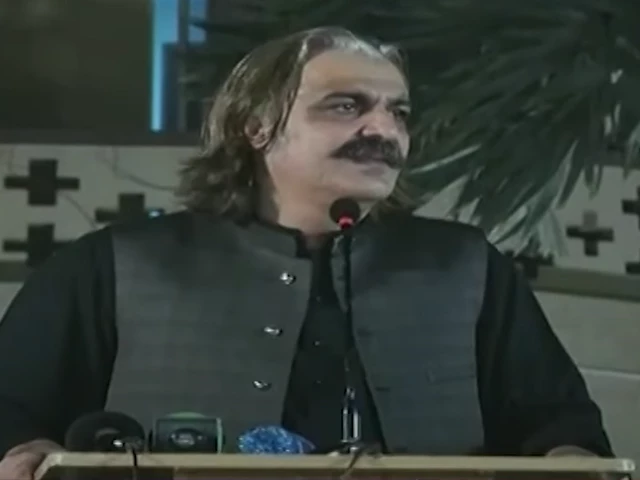
Khyber-Pakhtunkhwa Chief Minister Ali Amin Gandapur addresses a PTI meeting in Lahore on Saturday, July 12, 2025. Photo: SCREENGRAB
ISLAMABAD:

Ali Amin Gandapur was once the face of PTI’s resistance. Handpicked by jailed PTI founder Imran Khan as Chief Minister of Khyber Pakhtunkhwa, he was seen as a hardliner capable of sustaining the party’s confrontational posture while its leader remained behind bars.

He twice led protesters toward the capital, demanding Imran Khan’s release.
However, this past week, that image fractured. Gandapur found himself facing criticism from within his own ranks after giving interviews that questioned the party’s strategy. Once celebrated for defiance, he is now facing hostility from sections of the very support base that once hailed him.
The shift from hero to villain, analysts say, reflects deeper internal divisions within PTI and a widening lack of clarity over its strategic direction at a time when its central leadership remains under strain.
Gandapur claimed that while serving as chief minister, he had urged party leaders and even Imran Khan’s sisters not to pursue a hostile approach, but instead to focus on securing the PTI leader’s release. He further stated that Imran was misled in jail by some party leaders regarding the scale of street support.
His remarks triggered a strong reaction from party hardliners, who labelled him a “coward.”
Yet insiders suggest that Gandapur’s position is not isolated. Some within the party believe a recalibration of strategy is necessary rather than continued confrontation with the powers that be.
It was partly for this reason that Mehmood Khan Achakzai and Allama Raja Nasir Abbas were appointed as leaders of the opposition in the National Assembly and Senate, in the hope that their involvement might help open channels of communication with other stakeholders.
However, hardliners remain dissatisfied with the decision to empower the opposition alliance, Tehreek-e-Tahafuz-e-Aain Pakistan. Long-time party workers feel sidelined, believing that years of loyalty have not translated into influence within the evolving power structure.
Analysts point to a widening communication gap within the party. With the leader cut off from direct contact, confusion has seeped into the upper tiers. Critics have also questioned Barrister Gohar’s leadership, asking whether he was appointed merely to counter statements issued by other party figures.
Senior political analyst Hassan Askari characterises the situation as one of “leadership dependency and internal struggles.” “Many political parties are heavily dependent on their leadership, and with central figures like Imran Khan and a few others arrested or sidelined, the remaining second- or third-tier leaders struggle to maintain energy, direction, and internal coherence. Without a clearly established hierarchy or self-sustaining leadership, the party cannot pursue its intended agenda and lacks both a clear sense of direction and organisational focus, making strategic coordination and unified action increasingly difficult,” Askari told The Express Tribune on Sunday.
According to Zaigham Khan, responsibility lies in PTI’s structural evolution. He argues that the party continues to operate more as a movement than as a fully institutionalised political party, having never completed the post-power transition that established parties such as the Pakistan Peoples Party underwent.
“Its decision-making and mobilisation have long revolved around Imran Khan as the central authority, and his absence has exposed structural weaknesses such as a lack of hierarchy, weak institutional mechanisms, and leadership competition, producing the strategic confusion now visible within the party,” Zaigham said.
Beyond inte rnal organisational divides, the government views Imran Khan’s sister, Aleema Khanam, as a significant factor in ongoing tensions. The most recent episode concerns Imran Khan’s health, with Aleema insisting that the party maintain its sit-in until he is granted access to his own physicians.
The party chose otherwise. In a recent interview, she maintained that she was not interfering in party affairs but was focused on her brother’s health, suggesting that PTI leaders unwilling to fight for him should step aside.
Zaigham Khan describes Aleema Khanam as the most credible communication source within the party and one of its strongest internal power centres.