



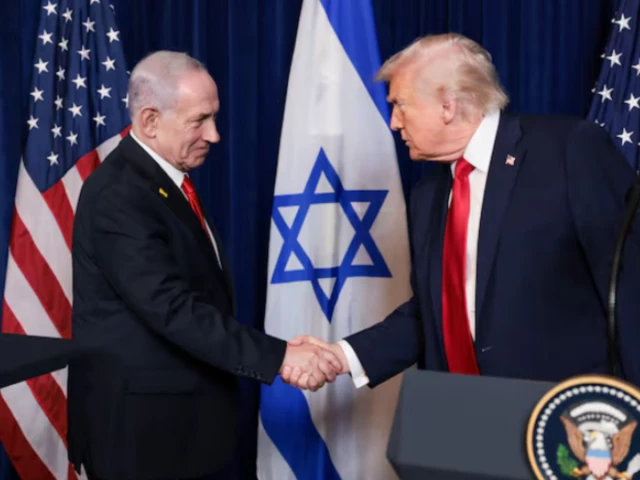

US President Donald Trump and Israeli Prime Minister Benjamin Netanyahu hold a press conference after meeting at Trump’s Mar-a-Lago club in Palm Beach, Florida, US, December 29, 2025. PHOTO: REUTERS
Israeli Prime Minister Benjamin Netanyahu said on Sunday that any US agreement with Iran must include the complete dismantling of Tehran’s nuclear infrastructure, not merely a halt to uranium enrichment.
Speaking at the annual Conference of Presidents of Major American Jewish Organizations, Netanyahu said he conveyed the same position to US President Donald Trump during talks last week.
“There shall be no enrichment capability — not stopping the enrichment process, but dismantling the equipment and the infrastructure that allows you to enrich in the first place,” he said, adding that enriched material must leave Iran under any future deal.

Read: Iran signals flexibility ahead of Geneva round of N-talks

A second round of US-Iran negotiations is expected later this week. An Iranian diplomat was reported as saying Tehran seeks an agreement that delivers economic benefits for both sides.
The United States and Iran resumed talks earlier this month to address their decades-old dispute over Iran’s nuclear programme and avert the risk of military escalation. US officials told Reuters that Washington has deployed a second aircraft carrier to the region and is preparing for the possibility of a sustained military campaign if negotiations fail.
Netanyahu said he remains sceptical of a deal.
Separately, the Israeli premier said Israel must “complete the job” of destroying Hamas tunnels in Gaza. He said Israeli forces have dismantled 150 kilometres of an estimated 500-kilometre tunnel network.
Read More: Iran open to compromises to reach nuclear deal with US, minister tells BBC
On US military assistance, Netanyahu said Israel aims to end American aid within the next decade after the current 10-year agreement — under which Israel receives $3.8 billion annually — expires in 2028.
“We can afford to phase out the financial component of the military aid that we’re receiving, and I propose a 10-year drawdown to zero,” he said.
“We want to move with the United States from aid to partnership.”

