




• Insists govt can’t create jobs for millions of people; private sector must lead employment drive
• Claims FIR registered against sitting senator over alleged tax evasion
• Says tobacco sector ‘not paying taxes’, involved in smuggling
• Construction relief package ‘in pipeline’, announcement expected soon
• Textile support under review; minister seeks 10-12 days for concrete steps
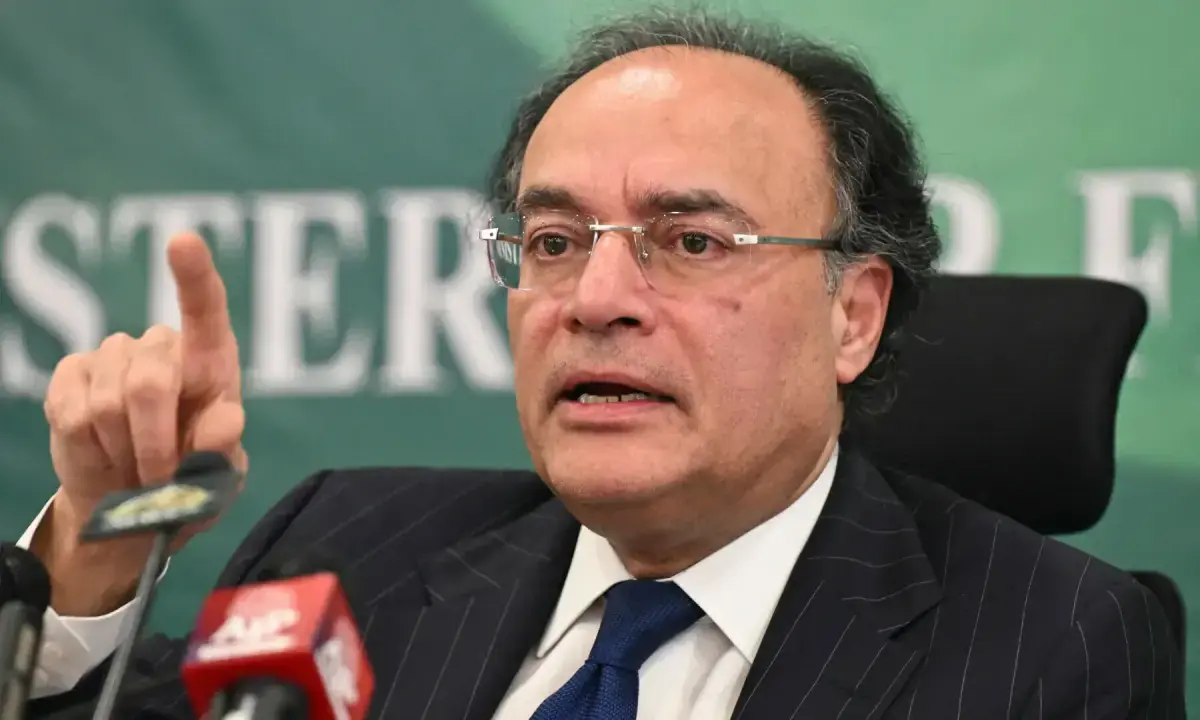
LAHORE: Finance Minister Muhammad Aurangzeb on Saturday warned that Pakistan could not be run with a rapidly increasing population and stressed that the private sector would have to take the lead and create employment opportunities.
“If this growth rate (2.5pc) continues, our population can reach 400 million in the coming years. So, you tell us who will run this country in such a situation,” he said while speaking at the Pakistan Economic Growth Conference at the regional office of the Federation of Pakistan Chambers of Commerce and Industry (FPCCI) in Lahore. “So please help us on how to control the population,” he added.
On employment, the minister said the government alone could not provide jobs to the entire population of 250 million. “The private sector should lead the country’s economy and provide jobs,” he said, adding that the government’s role was to strengthen and enable the private sector.

The minister emphasised the need to adopt the strategy that Bangladesh had used to control its population. “When you talk about Bangladesh with reference to taxation, competitiveness, growth, etc, while comparing with Pakistan, why don’t you talk about its journey to control population,” he questioned, requesting the businesspersons to come forward and help the government reduce the population growth.

Mr Aurangzeb said the government was making efforts to broaden the tax base, claiming that an FIR had been registered against a sitting senator over alleged tax evasion.
“Tobacco and cigarette companies, except for two, are not paying taxes. They are also involved in smuggling. But we are not sparing them. We got an FIR even against a sitting senator,” he said.
He said the government had started monitoring sales tax on goods starting with the sugar industry and would move to other sectors in phases. “The PM has instructed us to start this from the sugar industry since his family is engaged in this [sugar] business,” Mr Aurangzeb claimed.
The finance minister said that after economic stabilisation, industrialisation was essential for sustainable growth and reiterated that the government was pursuing an export-led policy.
He said relief measures for the construction sector were in the pipeline and would soon be announced by the prime minister, while support for the textile sector and possible reductions in taxes linked to the property sector were also under consideration.
He said digitisation would improve transparency and revenue collection and acknowledged that the salaried class bore a disproportionate share of the tax burden. He reiterated the government’s commitment to providing relief to salaried individuals.
Highlighting developments in the construction sector, the finance minister said the work was actively underway and efforts were being made to broaden the tax net.
He clarified that the real estate and construction sectors were being treated separately, adding that construction was linked with multiple allied industries.
He assured the business community that their issues would be addressed.
Speaking on the textile sector, he said that its issues were currently under review and requested 10 to 12 more days, assuring that concrete steps would be announced shortly.
He further stated that the government was reviewing the possibility of reducing multiple taxes in the property sector while carefully balancing fiscal responsibilities with sectoral demands.
Mr Aurangzeb said that the positive impact of Pakistan’s agreement with the International Monetary Fund (IMF) has begun to materialise, restoring the confidence of international financial institutions in Pakistan’s economy.
He said the country was now firmly on the path of stability and growth.
He acknowledged that difficult but necessary decisions were taken to ensure fiscal discipline, particularly when Pakistan faced the risk of default. While the 2022 floods severely affected the economy, he said the country had sufficient capacity to absorb the losses caused by the 2025 floods.
The finance minister described IT exports as the future of Pakistan’s economy, stating that current IT exports stood at $3-4 billion, with the potential to reach $8-10bn.
He stressed that export proceeds must be fully repatriated, as a significant portion — around $4-5bn — was currently retained abroad. He further stated that foreign exchange reserves held by the State Bank of Pakistan were increasing consistently.
“Due to prudent government policies, inflation has declined to record lows, providing tangible relief to the general public,” he said, reiterating that the salaried class would continue to receive priority relief measures.
Earlier, former minister Gohar Ejaz expressed concern over heavy taxation on real estate and other sectors, saying it was pushing investment abroad, particularly to Dubai.
“Pakistani people have already purchased properties worth $100bn in Dubai. A property expo for investment in Dubai is also being held in Lahore. And this city, after Karachi and other major cities, will be empty soon,” he deplored, requesting the government to reduce taxes on real estate and other sectors for economic growth.
Published in Dawn, February 15th, 2026

