



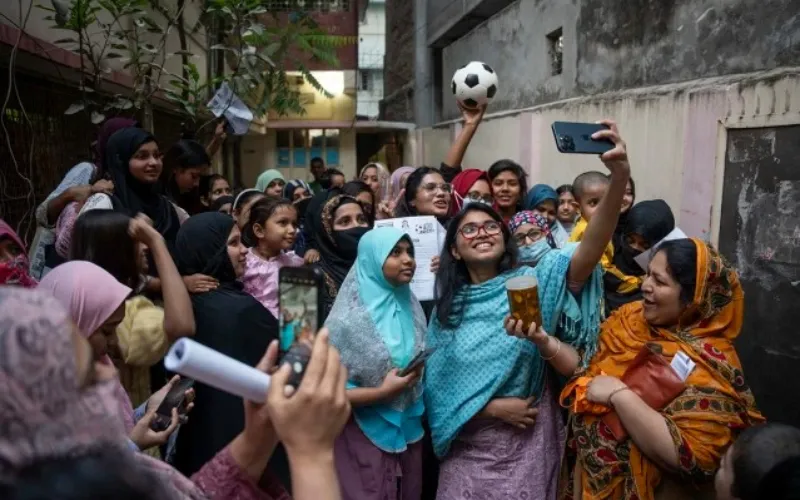

Bangladesh is holding a historic national election today, marking the first vote since a Generation Z-led uprising toppled long-time Prime Minister Sheikh Hasina in 2024. The election is being closely watched as a test of youth-driven reform and the country’s democratic resilience.
In August 2024, student-led protests erupted in Bangladesh over job quotas favoring individuals linked to the ruling party. These demonstrations, part of a broader wave of Gen Z activism across South Asia, ultimately led to Hasina fleeing to India and the establishment of an interim administration.
Millions of young Bangladeshis, many voting for the first time, are now at the center of the political stage. Student and youth activists are running for office, but analysts caution that institutional resistance could limit the movement’s impact and raise questions about the durability of post-uprising reforms.
Queues formed early at polling centers across Dhaka and other cities ahead of the 7:30 a.m. (0130 GMT) opening. The nation of 175 million people faces a pivotal moment after months of unrest driven largely by younger citizens demanding justice, fairness, and opportunity.

Political observers stress that a clear outcome is crucial to restoring stability and bolstering investor confidence, especially in Bangladesh’s garment sector, the world’s second-largest exporter.

“This is the first time a Generation Z-led uprising has directly preceded a national election anywhere in the world,” noted experts.
The main contest pits the Bangladesh Nationalist Party (BNP) against the Islamist Jamaat-e-Islami. Pre-election surveys suggest a slight advantage for the BNP. With Sheikh Hasina’s Awami League banned and the former prime minister in exile, the political landscape has shifted dramatically, potentially affecting Bangladesh’s regional alliances as relations with New Delhi cool and China seeks to expand influence.
More than 2,000 candidates from over 50 parties are competing for 300 parliamentary seats the largest number in the nation’s history. Voting in one constituency has been postponed due to a candidate’s death.
“This election is not routine,” said Nobel laureate Muhammad Yunus, head of the interim administration. “The people’s demand for justice, fairness, and equal opportunity is being expressed through the ballot.”
Alongside parliamentary elections, citizens are voting on a referendum proposing constitutional reforms. Measures include creating a neutral caretaker government during elections, introducing a bicameral parliament, increasing female representation, strengthening judicial independence, and limiting prime ministers to two terms.
The campaign period remained largely calm, with only minor disturbances reported. Security has been tightened nationwide, with nearly 958,000 police, army, and paramilitary personnel deployed.
Of the nearly 128 million registered voters, about 49% are women, yet only 83 female candidates are running. Almost half of all eligible voters are aged 18–35, many casting their first national ballots.
At a temporary polling station outside Dhaka, 32-year-old Ruma Khatun, wearing a burqa and displaying a henna design of Jamaat-e-Islami’s election symbol, said, “I want Dr. Shafiqur Rahman to become prime minister. He can guide the country toward justice and development.”
BNP’s Tarique Rahman and Jamaat chief Shafiqur Rahman are the leading contenders for prime minister. Despite challenges including migrant workers unable to travel home to vote and disappointment over the absence of Hasina’s party many citizens remain determined to seize this historic opportunity.
“Before, we couldn’t vote properly,” said Shakil Ahmed, a driver. “This time, I will make sure my voice is heard.”
Polling concludes at 4:30 p.m. (1030 GMT), with counting beginning immediately afterward. Preliminary trends are expected late Thursday night, with final results likely Friday morning.

