



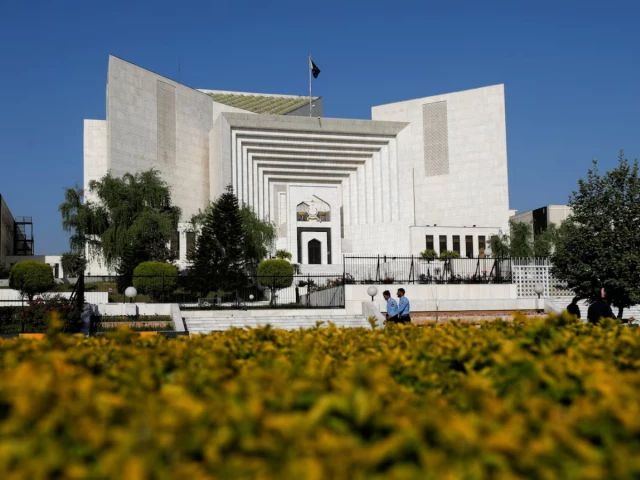

Police officers walk past the Supreme Court of Pakistan building, in Islamabad, Pakistan April 6, 2022. REUTERS
ISLAMABAD:
The Supreme Court has finally broken its silence and responded to the PTI’s memorandum in which the party urged the apex court to intervene to ensure that jailed PTI founder Imran Khan is regularly allowed to meet his family members, doctors and legal team.

“The concerns relating to access to the imprisoned PTI leader and the provision of medical reports were once again conveyed to the relevant executive authorities for appropriate consideration in accordance with law,” said a statement issued by the Supreme Court on Saturday.

The statement appeared a day after a delegation of opposition lawmakers submitted a memorandum to the Supreme Court registrar.
The SC statement revealed that, to address such eventualities in the future, the court has also issued Standard Operating Procedures (SOPs) for engaging aggrieved litigants.
The SOPs emphasise ensuring accessibility, facilitation and the provision of necessary amenities, including emergency medical cover, without compromising institutional decorum, judicial functions, or the rights of access of other litigants, it added.
However, the SOPs have yet to be made public. A senior Supreme Court official said they would be shared once formally notified. A section of lawyers, considered close to the executive, has questioned the legal backing of these SOPs.
They said if the government is not satisfied, the SOPs could be challenged before the Federal Constitutional Court (FCC), where judges are appointed by the incumbent prime minister.
A senior PTI leader said matters would become clearer once the SOPs were reviewed. He, however, maintained that it was a success for PTI if the development led to anything substantive.
Another section of lawyers said that, given the present government’s alleged defiance of judicial orders in matters related to the PTI and its founder, there is little chance that these SOPs would prove effective in ensuring fair treatment.
Since May last year, the Supreme Court’s judgment granting civilians the right to appeal against military court verdicts has yet to be implemented.
Similarly, judicial orders of the Islamabad High Court (IHC) directing that meetings with Imran Khan be facilitated in jail have not been complied with.
The Supreme Court statement, issued in response to PTI’s memorandum, noted that a group of parliamentarians affiliated with the PTI, including the Khyber-Pakhtunkhwa chief minister, gathered outside the Supreme Court on January 30, 2026, to register concerns regarding access to their imprisoned leader.
“The Registrar, Supreme Court of Pakistan, engaged with their representatives and assured them that the concerns would be brought to the notice of the Honourable Chief Justice of Pakistan. “Later in the day, their counsel, Salman Akram Raja, was granted an audience by the Chief Justice of Pakistan.
“During the interaction, concerns relating to access to the imprisoned PTI leader, including access by family members and medical professionals, were conveyed.
“As the matter raised did not directly pertain to proceedings pending before the Supreme Court, the concerns were referred to the relevant executive authorities for consideration in accordance with law, after which the gathering dispersed peacefully.
“In the absence of any communicated response for a week, the delegation, including opposition leaders in the Senate and the National Assembly, once again approached the Supreme Court on February 6, 2026, with a signed memorandum, which was formally received by the Registrar, Supreme Court of Pakistan.”
“The concerns relating to access to the imprisoned PTI leader and the provision of medical reports were once again conveyed to the relevant executive authorities for appropriate consideration in accordance with law,” the statement reiterated.
Since the passage of the 26th Constitutional Amendment, the PTI has found itself treading water in the superior courts, struggling to secure substantive relief as key petitions linked to its jailed founder and senior leadership remain in limbo, deepening the party’s legal and political uncertainty.
The party, whose founder Imran Khan has remained incarcerated for over two years, continues to approach the judiciary for hearings on his cases. However, progress has been slow, with PTI’s petitions stuck across multiple judicial forums.
Against this backdrop, Imran Khan’s lead counsel, Salman Safdar, on Friday wrote to IHC Chief Justice Sardar Muhammad Sarfraz Dogar, requesting early fixation of the petition seeking suspension of sentences awarded to Imran Khan and his wife, Bushra Bibi, in the Al-Qadir Trust case.
Explaining the basis for approaching the court, the letter stated: “What has prompted me to address Your Lordship through this letter is the failure of the IHC to redress the legitimate concern and fundamental right of the clients to have their post-conviction bail (suspension of sentence) applications fixed and heard in the criminal appeals arising out of NAB Reference No. 19/2023 (popularly known as the Al-Qadir University Trust case).”
Barrister Asad Rahim Khan commenting on this development says that a rent and family court need not bother with SOPs. It should concentrate on digitising files, or on inventorying lightbulbs and biscuits, he adds.

