



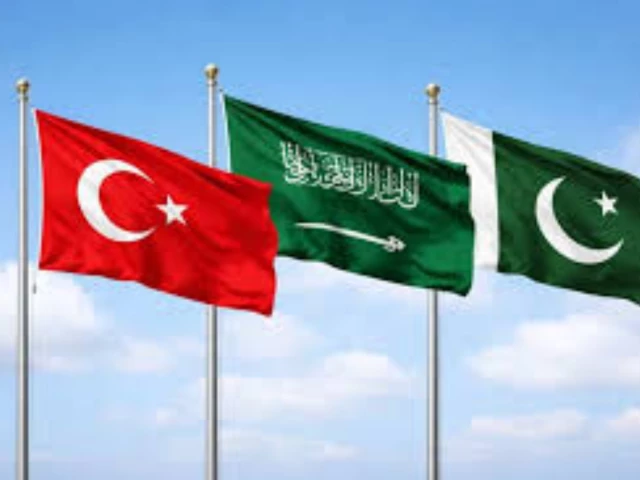

Raza Hayat Harraj says potential deal is separate from Pak-Saudi defence deal announced last year.
Defence Production Minister Raza Hayat Harraj has said that Pakistan, Saudi Arabia and Turkiye have prepared a draft defence agreement after nearly a year of talks, a signal that they could be seeking a bulwark against a flare-up of regional violence in the last two years.
Harraj told Reuters a day ago the potential deal between the three regional powers was separate from a bilateral Saudi-Pakistani defence deal announced last year. A final consensus between the three states is needed to complete the deal, he said.
“The Pakistan-Saudi Arabia-Turkiye trilateral agreement is something that is already in pipeline,” Harraj said in an interview. “The draft agreement is already available with us. The draft agreement is already with Saudi Arabia. The draft agreement is already available with Turkiye. And all three countries are deliberating. And this agreement has been there for the last 10 months.”

Read: No speculation warranted on defence engagements, say security sources

Asked at a press conference in Istanbul today about media reports on negotiations between the three sides, Turkish Foreign Minister Hakan Fidan said talks had been held but that no agreement had been signed.
Fidan pointed to a need for broader regional cooperation and trust to overcome distrust that creates “cracks and problems” that led to the emergence of external hegemonies, or wars and instability stemming from terrorism, in the region.
“At the end of all of these, we have a proposal like this: all regional nations must come together to create a cooperation platform on the issue of security,” Fidan said. Regional issues could be resolved if relevant countries would “be sure of each other”, he added.
“At the moment, there are meetings, talks, but we have not signed any agreement. Our President [Tayyip Erdogan]’s vision is for an inclusive platform that creates wider, bigger cooperation and stability,” Fidan said, without naming Pakistan or Saudi Arabia directly.
The development follows a Bloomberg report last week that said Turkiye is seeking to join a defence alliance between Saudi Arabia and nuclear-armed Pakistan, citing people familiar with the matter. The move could pave the way for a new security alignment with the potential to shift the balance of power in the Middle East and beyond.
According to the report, the proposed expansion appears to build on a defence arrangement initially signed by Saudi Arabia and Pakistan in September, under which “any aggression” against one country would be treated as an attack on all. The provision mirrors Nato’s Article 5, an alliance in which Turkiye has the second-largest military after the United States.
People familiar with the talks said discussions were at an advanced stage and a deal was likely. They added that the expanded alliance made strategic sense as Turkiye’s interests increasingly overlap with those of Saudi Arabia and Pakistan across South Asia, the Middle East and parts of Africa.
The report said Ankara also views the pact as a means to strengthen security and deterrence at a time when questions have been raised about the reliability of the US and President Donald Trump’s commitment to Nato, despite Washington’s strong military ties with all three countries.
Turkiye and Pakistan already enjoy close defence cooperation. Ankara is building corvette warships for Pakistan’s navy and has upgraded dozens of Pakistani F-16 fighter jets. Turkiye is also sharing drone technology with both Pakistan and Saudi Arabia and is seeking their participation in its Kaan fifth-generation fighter jet programme, Bloomberg reported earlier.
Meanwhile, Pakistan is also engaged with several countries over the sale of its JF-17 fighter jets following its military performance against India in Marka-e-Haq in May 2025.
Prime Minister Shehbaz Sharif confirmed a day ago that Pakistan’s defence exports were drawing increased international interest following last year’s military successes.
“Since our armed forces achieved success last year, global demand for our fighter jets has increased considerably. Several countries are actively engaging with Pakistan on this front, which will bolster our defence production and provide a significant boost to the national economy,” he said.
The developments also align with a recent Reuters report which said Pakistan and Saudi Arabia were in talks to convert around $2 billion in Saudi loans into a JF-17 fighter jet deal, citing two Pakistani sources.

