




Special forces remove Venezuela president, wife to NY; US takes control of Venezuela’s huge oil reserves
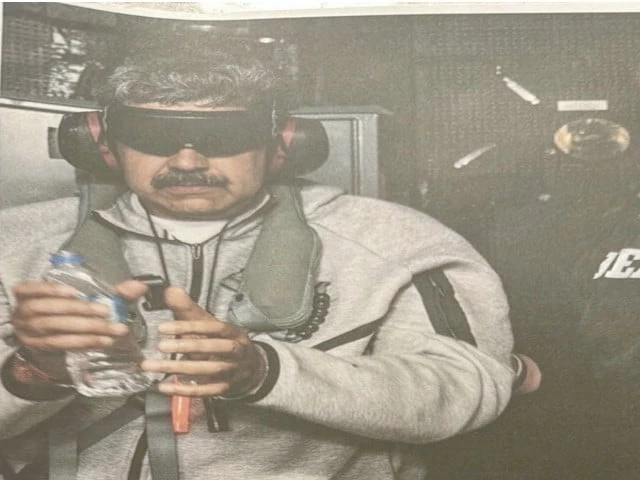
An image posted on US President Donald Trump’s Truth Social account shows Venezuela’s President Nicolas Maduro onboard the USS Iwo Jima after American military captured him. Photo: Reuters
In a dramatic escalation in Latin America, US special forces captured Venezuelan President Nicolas Maduro after bombing capital Caracas and other cities, President Donald Trump announced on Saturday, marking the most direct intervention by Washington in the region since the 1989 invasion of Panama.
The overnight operation, reportedly carried out in coordination with US law enforcement, involved elite special forces units, and followed months of accusations by Washington that Maduro ran a “narco-state” and manipulated Venezuela’s 2024 elections.

“The United States of America has successfully carried out a large-scale strike against Venezuela and its leader, President Nicolas Maduro, who has been, along with his wife, captured and flown out of the country,” Trump posted on Truth Social.

Trump later held a press conference, announcing that the US will indefinitely “run the country” of Venezuela and “rebuild the oil infrastructure”. He said the US would take control of Venezuela’s massive oil reserves and recruit American companies to invest billions of dollars to refurbish the oil industry.
The Venezuela leader was expected to arrive in New York, where he will face drugs and weapons charges. His wife, Cilia Flores, was also taken into custody after the couple was dragged from their bedroom by elite US forces during the overnight raid, a CNN report said.
Washington accused Maduro of overseeing drug trafficking into the US, and its expanded military and economic measures, including strikes on suspected drug vessels. Deputy Secretary of State Christopher Landau said Maduro will “finally face justice for his crimes.”
The Venezuelan leader, a 63-year-old former bus driver handpicked by the dying Hugo Chavez to succeed him in 2013, has denied those claims and said Washington was intent on taking control of his nation’s oil reserves, the largest in the world.
Explosions rocked the Venezuelan capital Caracas and surrounding areas, including Miranda, Aragua, and La Guaira, prompting the government to declare a national emergency. Venezuela’s government said civilians and military personnel died in the strikes but did not give figures.
Witnesses described black smoke and bright flashes in the sky, while power outages disrupted parts of the city near military bases. However, despite the strikes, initial assessments reported that Venezuela’s oil production and refining facilities remained operational.
Venezuelan officials condemned the attack. The Maduro government blamed Washington for attempting to seize the country’s oil reserves, the largest in the world, and called the strikes a violation of sovereignty.
Vice President Delcy Rodriguez, who is reportedly in Russia, demanded proof of life for Maduro and his wife, while Interior Minister Diosdado Cabello appeared on state television in Caracas urging citizens not to cooperate with the “terrorist enemy.”
Defence Minister Vladimir Padrino vowed to resist the presence of foreign troops. “Free, independent and sovereign Venezuela rejects with all the strength of its libertarian history the presence of these foreign troops, which have only left behind death, pain and destruction.”
However, Venezuela’s opposition leader María Corina Machado called for an opposition candidate to be installed as leader, while the county’s foreign minister insists Maduro remains the country’s head. The capital voiced mixed reactions, with some celebrating. By sunrise, uncertainty remained high.

