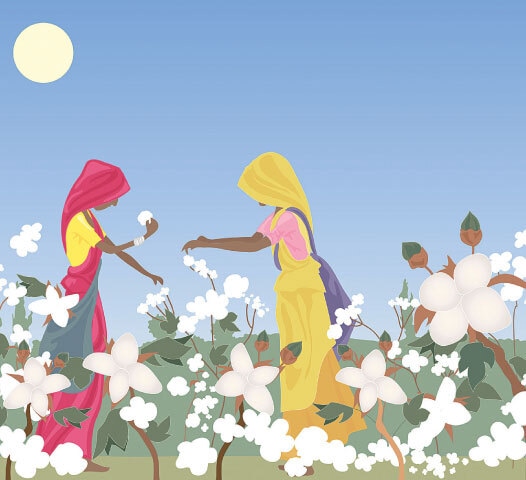

Pakistan has experienced a massive decline in cotton production over the last decade — from 13.9 million bales in FY15 to 7.08m bales in FY25. Meanwhile, the crop area decreased from 7.31m to 5.04m acres as per Pakistan Economic Survey data. Resultantly, State Bank data shows that Pakistan, which was once a net exporter of cotton, imported cotton and cotton yarn (HS code 52) worth $3.13 billion in FY25.
Recently, the Deputy Prime Minister of Pakistan chaired an inter-ministerial meeting — attended by the All Pakistan Textile Mills Association — to deliberate on the revival of cotton. In fact, the revival plan is based on a core assumption: that developing improved seed varieties through intensive research and development, ensuring quality seed production, and delivering these seeds effectively to farmers will restore cotton production.
However, ground realities have fundamentally changed over the past decade, and the factors driving cotton’s decline have become far more complex than seed quality alone.
For policymakers, it is crucial to recognise that in Pakistan — where crop zoning has never been enforced — farmers increasingly base their crop choices on financial returns. Shrinking landholdings and mounting economic pressures have made profitability the overriding factor. When a crop offers greater returns, a large number of farmers shift quickly, regardless of higher production costs, labour requirements, or operational difficulties involved.

Any agriculture policy that overlooks its impact on farmers’ earnings is bound to fail

A recent example is the rapid expansion of potato cultivation — a cost-intensive crop demanding careful management. Similarly, sesame acreage surged two years ago when local prices hit Rs17,000 per 40kg. However, its area shrank sharply when prices fell to around Rs10,000. Therefore, any policy that overlooks its impact on farmers’ earnings is bound to fail.
In many cotton-growing areas, farmers who traditionally followed the cotton–wheat cropping pattern now have a broader set of options. In well-irrigated zones, crops such as sugarcane, rice, and maize — and sesame in relatively water-scarce areas — have increasingly replaced cotton because they offer higher returns and carry lower production risks.
By contrast, cotton faces the highest production risks due to intense pest and disease pressures. These risks have intensified in recent years because of increased humidity at the microclimate level in cotton zones, caused by the expansion of high-delta crops like sugarcane and rice. Additionally, erratic rainfalls induced by climate change now adversely affect the crop during flowering, boll formation, and later stages.
Surprisingly, the government extension advisory, which once prohibited sowing before May 20, now recommends sowing in February and March so that farmers can get maximum harvest before the onset of adverse weather in July and beyond.
However, early sowing does not align with the cotton–wheat rotation, as wheat fields in Punjab are typically only cleared by mid-April at the earliest. This delay leaves farmers with little choice but to drop cotton from their cropping pattern. Consequently, cotton is now largely concentrated in areas such as the Bahawalpur division (in Punjab), where farmers have limited Kharif alternatives due to water shortages or soils and agro-climatic conditions unsuitable for rice, maize, or sugarcane.
Additionally, in several parts of the cotton belt, farmers have increased cropping intensity to three crops per year — wheat, sesame, and maize or wheat, sesame, and rice (1509 variety) — enabled by the availability of short-duration varieties.
Given the current situation, cotton cannot be revived unless its farm-level economics improve. One option is to raise cotton prices, such as via support prices, but this is unlikely in a deregulated market where prices follow international trends. Furthermore, the growing use of synthetic and plant-based fibres — viscose, tencel, modal — may further constrain cotton prices in the future. Another approach is to lower production costs via crop-specific subsidies, but international financial institutions may resist such measures.
This leaves only one sustainable option: boosting yields. However, it requires high-yielding cotton varieties suited to Pakistan’s agro-climatic zones, resilient to climate change, and compatible with mixed-cropping systems prevalent in historically cotton-rich districts such as Vehari, Khanewal, Lodhran, and Multan.
Unfortunately, such varieties are currently lacking, and developing them locally could take many years. Alternatively, importing proven varieties from reputable multinationals — following successful completion of mandatory two-year field trials — could provide a faster solution.
Unfortunately, even if yields are increased by 50 per cent — the current average being 717kg of lint per roughly 2.5 acres — cotton would still struggle to match the financial returns of sugarcane, rice, and maize. Its high production costs and risks, driven by the need for 10–12 pesticide applications to control sucking pests, make it increasingly difficult to entice farmers back to cotton.
Therefore, rather than pursuing crop zoning — politically contentious and hard to enforce — the most practical strategy is to concentrate efforts on non-traditional areas in Balochistan and Punjab, such as Lasbela, Mianwali, Layyah, Bhakkar, etc. These are predominantly semi-irrigated or water-scarce and naturally experience lower pest pressure. Notably, India has successfully expanded cotton production in its rain-fed regions through introducing Bt cotton hybrids which perform well under water-limited conditions.
In conclusion, Pakistan needs an out-of-the-box, medium-term cotton revival plan that safeguards the interests of all stakeholders — especially farmers. Without such balance, powerful groups will continue to push the revival agenda that best serves their own interests, while ignoring ground realities and the broader needs of the cotton sector as well as the country.
Khalid Wattoo is a development professional and a farmer, and Dr Waqar Ahmad is a former associate professor at the University of Agriculture, Faisalabad.
Published in Dawn, The Business and Finance Weekly, December 15th, 2025