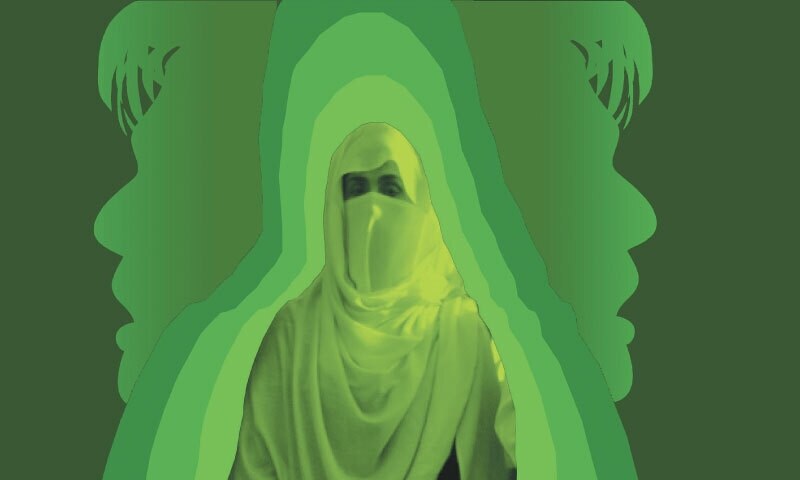

On November 14 of this year, The Economist’s sister publication, 1843, ran a feature on the controversial spiritual influence of Bushra Bibi — the current wife of former Pakistani prime minister Imran Khan, who is now in jail. Bushra Bibi is also currently incarcerated and it is widely believed that Khan remains captivated by her ‘roohani [spiritual]’ powers. 1843 also quoted former close comrades and house staff of the couple, more than alluding to her use of ‘magic’ to maintain Khan’s power and control his opponents.
But the content of the feature was hardly groundbreaking for most Pakistani media personnel. They were already aware of the details that the feature elaborated. However, when allegations about the couple appeared in a highly respected international magazine, the reaction was explosive.
Khan’s opponents capitalised immediately on social media, while journalists who had previously been lambasted by Khan’s party for airing what were dismissed as unfounded rumours, viewed the feature as validation of their long-held suspicions. Khan’s critics accused Bushra Bibi of directly interfering in politics throughout Khan’s tumultuous tenure, an accusation that starkly contrasted with Khan’s public insistence that she was “just a pious housewife”.
Then there were those who derided Khan himself, suggesting that, despite his Oxford education, he was in reality a highly superstitious and irrational individual. Finally, a third group criticised the 1843 feature itself, arguing that it was ‘sexist’ for laying the blame for everything that went wrong with Khan’s government squarely at Bushra Bibi’s feet.

From Islamabad to Pyongyang, authoritarian rulers often use myths, ‘magic’ and the ‘supernatural’ to command loyalty, silence rivals and turn political authority into something ‘sacred’

I posit that this situation mirrors countless examples where politicians strategically exploited beliefs in magic and the supernatural. This tactic is often deployed to instil fear in the populace and scare off rivals, especially in regions where such beliefs are widespread. Fundamentally, this strategy is a practical application of the broader ‘politics of fear’ tactic, designed to exploit psychological vulnerabilities for political advantage.
François ‘Papa Doc’ Duvalier, the dictator who ruled Haiti from 1957 to 1971, is a prominent example of a leader portraying himself as utilising ‘voodoo’ and magic for authoritarian control. Duvalier established a powerful cult of personality by merging brutal authoritarianism with voodoo mysticism. He modelled his demeanour on the Haitian ‘spirit of the dead’. This allowed him to cultivate an image of a magical ruler, leveraging deep-seated spiritual beliefs and fears among the populace. He claimed to have connected his regime with the spiritual world.
He was able to consolidate his power, especially over the rural population, who were predominantly voodoo practitioners. His tyrannical paramilitary force, dubbed the Tontons Macoutes, derived its name from a figure in Creole folklore — a bogeyman who kidnaps disobedient children. This naming strategy effectively utilised cultural fear and superstition as a tool for political repression.
The Kim Dynasty in North Korea maintains control by cultivating a pervasive mythology that attributes supernatural powers and divine status to its leaders. State-sponsored tales suggest that the ruling Kims can perform supernatural feats, such as being able to control the weather. These non-rational narratives solidify the Kims’ absolute authority, elevating them beyond the status of mere political rulers.
Former Iraqi dictator Saddam Hussein cleverly leveraged rumours of the occult to instil fear and psychologically undermine the opposition. Saddam and his family were widely rumoured to employ sorcerers to protect their regime and forecast the moves of their enemies. Stories circulated among the public that Saddam possessed a magic stone or talisman, rumoured to be implanted under his skin, which rendered him invulnerable to harm. The belief that the dictator was magically protected served as a powerful psychological deterrent, suppressing any internal movements before they could seriously challenge his power.
Even in a democracy such as Sri Lanka, with an ostensibly modern political culture, superstition and traditional beliefs remain significant in politics. According to political scientist O.N. Thalpawila, many Sri Lankan politicians continue to adhere to traditional superstitious beliefs, notably depending heavily on astrology to guide and advance their political careers. Thalpawila suggests that Lankan politicians openly embrace and confess these supernatural beliefs to gain traction and support from a populace that also shares these beliefs.
These are but just a few modern illustrations of a timeless authoritarian tactic: rulers claiming to possess or utilise supernatural powers over a population, particularly when large segments of that populace adhere to traditional or superstitious beliefs. This practice transforms political authority into a sacred or terrifying force.
The political use of the supernatural is a double-edged sword, though. While some leaders project divine power, others use accusations of black magic to destroy their opponents’ reputations. These accusations can severely damage an opponent’s reputation and credibility.
Khan often framed Bushra Bibi as a pious, Sufi figure, arguing that his political rivals were deliberately attempting to demonise her as a ‘witch’ to discredit him. One cannot outrightly dismiss this. However, the accusations were not limited to external rivals. Even elements within Khan’s own political party, wary of her increasing political influence over him, allegedly described her as a diabolical person using magic for nefarious purposes.
Conversely, some observers speculated that Bushra Bibi’s spiritual persona was a calculated act, exploiting Khan’s reputed superstitious nature and naïveté for political gain. It is also highly probable that the couple publicly engaged in forms of ‘spiritualism’ commonly practised by the rural populace (especially in Punjab), to gain traction and secure political support from these segments.
It is also likely that Bushra Bibi actively cultivated her growing reputation as a powerful practitioner of supernatural forces, including the rumour that she was served by djinns, as a strategic means to control her opponents, both within Khan’s party and among rivals outside of it.
The political behaviour of Khan and Bushra Bibi, characterised by repeated verbal and public actions suggesting they were guided by supernatural forces (which they often framed as ‘Sufism’), certainly made all the previously discussed scenarios plausible. Their explicit reliance on this perceived spiritual guidance created a powerful narrative. However, it also opens the door to a question: if this claimed ‘Sufism’ was so potent, why has it not been effective in securing Khan’s release from prison and restoring him to the prime minister’s office?
While it is true that their opponents likely fuelled significant exaggeration regarding the couple’s spiritual practices, it is undeniable that the couple themselves created the space and justification for these exaggerations to take root and spread.
Published in Dawn, EOS, December 7th, 2025