



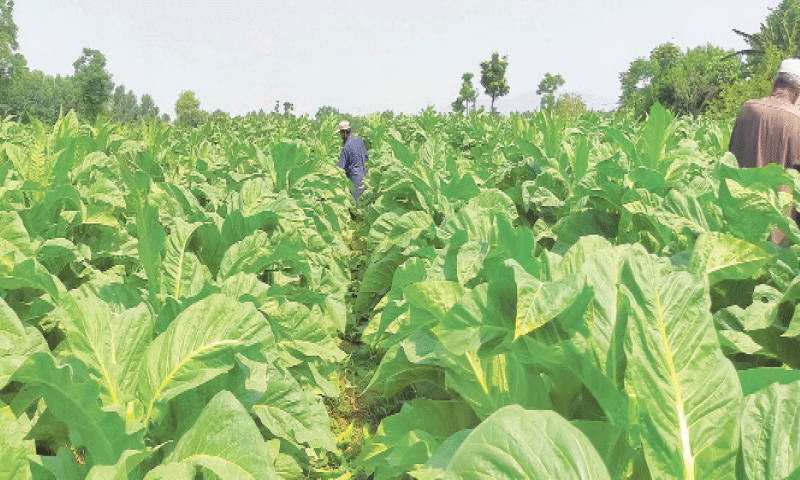

• Farmers face financial strain amid limited storage, low prices
• Firms cut purchases by 23m kg in four years
SWABI: Tobacco purchasing companies have slashed their demand for the 2026 crop by 13.183 million kg, marking the fourth consecutive year of reduced requirements. This cutback is expected to result in significant financial losses for local tobacco farmers, sources told Dawn on Saturday.
Tobacco experts noted that while multinational and national firms have the capacity to store large quantities of tobacco, growers face major challenges due to limited financial resources and storage options. The inability to store crops like Virginia and White Patta tobacco means any surplus must be sold quickly, leaving growers at the mercy of fluctuating market demand.
For 2026, the total demand from tobacco companies is set at 61.627m kg, with 58.184m kg of flue-cured Virginia (FCV) tobacco, 0.360m kg of dark air-cured tobacco, 1.342m kg of White Patta, 1.381m kg of burley, and 0.360m kg of sun-cured tobacco.

This marks a significant reduction from previous years, with companies cutting their demand by 23.873m kg over the past four years. In 2023, total demand was 85.5m kg, which fell to 77.322m kg in 2024, 74.810m kg in 2025, and will drop to 61.627m kg in 2026.

The bulk of tobacco purchases is made by multinational companies, with a smaller portion allocated to national companies and smaller tobacco entrepreneurs. Among multinational firms, Pakistan Tobacco Company (PTC) and Philip Morris (Pakistan) Ltd are the largest buyers, with a combined demand of over 36m kg of FCV tobacco in 2026. The remaining FCV demand will be met by 78 national companies, including Khyber Tobacco.
Shift in tobacco requirements
The Pakistan Tobacco Board (PTB) has noted that while demand for FCV, dark air-cured, and sun-cured tobacco has decreased in 2026, demand for White Patta and burley tobacco has increased slightly. FCV tobacco remains the primary focus for both multinational and national companies, given its use in cigarette manufacturing and export.
Iqbal Shewa, a prominent tobacco grower, stressed that both multinational and national companies are primarily concerned with FCV tobacco for export and cigarette production. To avoid confusion during the purchasing season, PTB has instructed tobacco companies and landowners to formalise agreements for the upcoming year and share those agreements with the board. Farmers have been advised to grow tobacco in line with these agreements to avoid complications during the buying season.
Price discrepancies and low profit
Ayaz Khan, a former PTB director, explained that companies are reducing their demand for the 2026 crop in part because of the price discrepancy between the weighted average price (WAP) and the minimum indicative price (MIP). The WAP for the current year was set at Rs 719 per kg, while the MIP for surplus tobacco was set at Rs 545 per kg. Companies, Mr Khan said, profited from purchasing surplus tobacco at the MIP, which was Rs174.8 less than the WAP, resulting in significant savings for them but at the expense of the growers. This year’s surplus tobacco amounted to 35.35m kg, which allowed companies to profit by Rs6.17 billion, a windfall that was not shared with the farmers.
In contrast, the farmers have faced significant losses. The lower purchase prices have put them in a difficult financial position, with many reliant on tobacco cultivation for their annual income.
Surging exports
Despite the reduced demand for domestic consumption, tobacco exports have seen a marked increase. In 2023-24, Pakistan exported 20m kg of tobacco, rising to 47m kg in 2024-25, an increase of 135pc year-on-year. However, despite this rise in exports, companies have kept their domestic purchase demand low to avoid paying higher prices for surplus tobacco.
Mr Khan also pointed out that the increased exports have not led to corresponding benefits for local growers. Instead, the companies’ strategy of reducing domestic purchases and capitalising on cheaper surplus tobacco has disproportionately benefited the tobacco industry, while the farmers and government have borne the brunt of the financial losses.
The ongoing reduction in tobacco demand by purchasing companies is creating a challenging environment for tobacco growers, who face severe financial losses due to lower prices and limited storage options. While companies continue to benefit from price discrepancies and increased exports, farmers remain the biggest losers in this equation.
Published in Dawn, November 23rd, 2025

