
77pc of 10-year-olds unable to read and understand simple text, reveals report – Pakistan


ISLAMABAD: The country continues to face critical challenges in financing and ensuring access to education, reveals a government report released on Thursday.
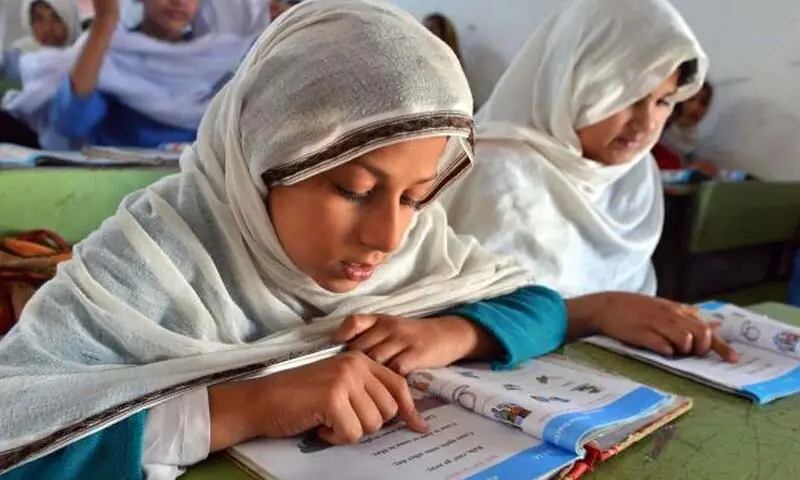
With an alarming number of out-of-school children and 77 per cent of ten-year-olds unable to read and understand a simple text, the urgency of aligning financing priorities with teacher quality, learning materials, and stronger assessment systems has never been greater.
Whereas the country’s declining trend in education spending reflects a progressive weakening of education’s position within the national fiscal framework.
This was pointed out in a new 171-page report titled “Public Financing in Education 2025-26” released by Pakistan Institute of Education (PIE) –a subsidiary of the Ministry of Federal Education and Professional Training in Islamabad.

The report covered low funding in overall education sectors, the role of provincial foundations, learning outcomes, underfunded special education and several other areas.

The report analysed education financing from 2019–20 to 2023–24.
It said: “Education expenditure as a share of Gross Domestic Product (GDP) has remained persistently below international benchmarks, averaging under 2pc—less than half the recommended 4–6pc under the UNESCO Education 2030 Framework for Action.

“The share of education expenditure in Pakistan has remained well below these benchmarks over the past five years and has shown a declining trend. Education spending stood at 1.9pc of GDP in 2019–20, dropped to 1.4pc in 2020–21, rose temporarily to 1.7pc in 2021–22, and declined again to 1.5pc in 2022–23. The figure for 2024–25 is provisionally estimated at 0.8pc, based on expenditure data from July 2024 to March 2025,” the report revealed.
“This downward trajectory [..] [raises] serious concerns about the adequacy of resource allocation to the sector. The persistent gap between actual allocations and internationally recommended levels — with Pakistan allocating less than half of the minimum recommended share — highlights the urgent need to strengthen the prioritisation of education within public spending,” the report pointed out.
Addressing the issue of learning outcomes, the report in its executive summary stated: “The country continues to face critical challenges in education access and outcomes”.
“With 25.37m out-of-school children [contrary to last week’s figure of 26.2m OOSC released also by PIE] and 77pc of ten-year-olds unable to read and understand a simple text,” it said, adding that recent NAT and ASER findings further highlight persistent gaps in foundational literacy and numeracy.
“These challenges have been compounded by external shocks, including the 2022 floods, which destroyed thousands of schools and disrupted learning for millions of children.”
It said that resource distribution between the federation and provinces continues under the Seventh National Finance Commission (NFC) Award, announced in 2009 and still in effect.
At the provincial level, Balochistan does not have a notified Provincial Finance Commission (PFC) award. It noted that other provinces have not introduced new PFC awards in recent years, resulting in ad hoc arrangements for intra-provincial transfers.
“Although total spending increased significantly from 2019-20 to 2023-24—rising between 50pc to 140pc across provinces—the real value of these budgetary allocations either stagnated or declined after adjusting for inflation, barring Balochistan,” read the report.
While pointing out that trends in Education Expenditure (2019-20 to 2025-26), the report stated that education expenditure and allocation trends for 2024–25 and 2025–26 show continued nominal increases in education spending across most provinces and at the federal level, indicating sustained fiscal prioritisation of the sector.
“However, the impact of these increases will depend on effective utilisation and their translation into improved education outcomes,” the report said.
Expenditure by education level
The report stated that at the functional level, pre-primary and primary education together with secondary education accounted for more than two-thirds of total national education financing, while tertiary education and administration represented smaller shares.
However, a substantial portion of allocations also fell under “Other Education Services (including Administration)”, particularly in Sindh, where nearly 70pc of the development budget was attributed to this category without a clear indication of how the funds are utilised.
This lack of disaggregation restricts analytical precision, obscures the true picture of spending across education levels, and limits evidence-based decision-making, the report said.
“Pakistan’s education financing needs to move from an incremental, input-focused model to one that is transparent, equitable, and results-oriented. Two reforms are especially urgent. First, introducing gender-, locality-, and school-level budgeting is critical for improving equity and resource targeting. Second, standardised budget tagging across provinces is needed to improve transparency and comparability.”
The report, giving a breakdown of the total education budget by province/region (2023-24), stated that the aggregate national education budget for 2023–24 reflected the distribution of education financing across provinces and regions, highlighting the scale and fiscal capacity of each government.
Punjab accounted for the largest share at 37pc of the total education budget, followed by Sindh and Khyber Pakhtunkhwa, each contributing 21pc. The federal government represented 10pc of total allocations, primarily driven by higher education and administrative functions. Balochistan contributed 7pc, while Azad Jammu and Kashmir and Gilgit Baltistan accounted for 3pc and 1pc, respectively.
This distribution highlights the dominance of provincial financing in the education sector, consistent with Pakistan’s devolved governance framework, according to the report.
“The share of education within the total expenditure of each respective government provides insights into sectoral prioritisation and fiscal commitment at different levels of government. KP demonstrated the strongest commitment to education, recording the highest average over the past four years at 25pc and rising further to 27pc in 2023–24. AJK followed with an average of 24pc but showed a slight decrease to 22pc in 2023–24. Balochistan and GB showed a relatively steady pattern, while Punjab and Sindh displayed modest reductions.
Understandably, the federal government allocated only 1pc of its total budget to education, both on average and in 2023–24. In the Punjab, Sindh, KP, Balochistan, AJK, and GB, Federal Average 2023-24, AJK recorded the second-highest average share of total government expenditure on education from 2019–20 to 2022–23.”
Expenditure per teacher: In nominal terms, per-teacher expenditure in 2023–24 was highest in the Federal Directorate of Education at Rs1.84m, followed by GB (Rs1.52m), Sindh (Rs1.35m), KP (Rs1.32m), Punjab (Rs1.30m), Balochistan (Rs1.28m), and AJK (Rs1.24m), indicating relatively limited variation in per-teacher spending across jurisdictions.
Expenditure on students: Pre-primary & primary, in 2023–24, nominal per-student expenditure at the pre-primary and primary level was highest in the Federal Directorate of Education (Rs72,124), followed by Balochistan (Rs69,621), Punjab (Rs40,895), AJK (Rs34,103), Sindh (Rs26,027), KP (Rs25,867), and GB (Rs22,332).
Across all provinces and regions, nominal spending per student increased over the period; however, these gains were largely eroded once adjusted for inflation.
In 2023–24, nominal per-student expenditure at the secondary level was highest in Gilgit Baltistan (Rs96,668), followed by KP (Rs78,337), AJK (Rs77,825), Balochistan (Rs57,981), Sindh (Rs51,335), FDE (Rs50,916), Punjab Sindh KP Balochistan AJK GB Federal Directorate of Education Nominal Real Public Financing in Education 2025-26 Punjab (Rs27,599).
At this level, nominal growth in per-student expenditure appeared stronger than at the pre-primary and primary level; however, real values declined across many of the provinces and regions once inflation was accounted for.
Gross Enrolment Ratio (GER)
The report stated that at the primary level, Punjab and KP reported consistently high GERs, standing at 88pc and 79pc respectively in 2023–24.
Sindh, despite modest improvement, remained considerably lower at 65pc, while Balochistan lagged with only 40pc. AJK and GB recorded 82pc and 86pc GER, respectively.
However, GERs declined sharply at higher levels of schooling. At the middle level, the report said that Punjab achieved 69pc, followed by KP (56pc) and Sindh (47pc), while Balochistan recorded only 22pc. This downward trajectory continued at the high and higher secondary levels, where no province exceeded 54pc, and participation fell to as low as 20pc in Sindh and 24pc in Balochistan.
Learning outcome
The report stated that at the grade 4 level, Punjab consistently outperformed other provinces, with students correctly answering 71pc of English items, 64pc of Mathematics items, and 94pc of foundational learning tasks. Sindh trailed behind, with scores of 59pc in English, 49pc in Mathematics, and 72pc in foundational learning, while KP, Balochistan, AJK, and GB reported lower performance, particularly in Mathematics, where proficiency rates ranged between 31pc and 44pc. Language outcomes also varied, with Punjab (81pc) and Balochistan (65pc) outperforming GB (57pc) and KP (57pc) in Urdu/Sindhi comprehension.
By grade 8, the gaps persisted. Punjab again recorded the highest performance, with 64pc of Science items and 53pc of Mathematics items answered correctly. Other provinces remained considerably below these levels, with Sindh at 49pc in Science and 41pc in Mathematics, and KP, Balochistan, AJK, and GB reporting scores below 45pc in both subjects.
“These results highlight widespread challenges in ensuring that students acquire core competencies by the end of middle school, particularly in mathematics,” the report highlighted.
Special education
According to the Population and Housing Census 2023, Pakistan has 3.8m children aged 5–16 years living with disabilities, representing 5.4pc of the school-age population. Despite the scale of need, provincial special education departments cater to only a fraction of these children.
In Punjab, 38,478 students are enrolled in 293 special education schools—covering just 1.70pc of the province’s school-age population living with disabilities.
Sindh, with 65 schools, reaches 4,283 students (0.57pc), Balochistan manages 16 schools — serving 891 students (0.71pc), while KP, with only three schools, serves a negligible proportion of its 678,000 children with disabilities.
“The limited reach of provincial special education systems is closely linked to the scale of government financing.”
In 2023–24, Sindh and Punjab spent the highest proportions of their education budgets on special education—1.68pc and 1.60pc, respectively—while KP and Balochistan devote only 0.37pc and 0.12pc.
In absolute terms, Punjab spent Rs9,053m, followed by Sindh with Rs5,535m, KP with Rs1,186m, and Balochistan with Rs120m.
“Across all provinces, special education accounted for less Public Financing in Education 2025-26 than 2pc of total education expenditure, reflecting its marginal fiscal weight despite the significant number of children requiring dedicated services.”
However, expenditure trends over the five years from 2019–20 to 2023–24 showed notable growth in nominal terms, suggesting a gradual expansion in financial commitment.
Balochistan and Sindh recorded the largest increases in special education spending—165pc and 164pc, respectively—though from relatively low bases. Punjab’s expenditure rose by 80pc, maintaining the highest absolute outlay, while KP recorded a more modest increase of 44pc.
The report highlighted that within provincial Annual Development Programmes (ADPs) and Public Sector Development Programmes (PSDPs), special education schemes are often categorised under the Social Welfare sector rather than Education.
In 2023–24, KP allocated Rs363m and Balochistan Rs148m to education-related schemes through their Social Welfare sectors. Taken together, these findings show that special education in Pakistan remains underfunded and fragmented and accounted for less than 2pc of total education expenditure in all provinces in 2023–24.
Education foundations
The report said that Punjab Education Foundation (PEF) has expanded steadily, but with modest growth in teachers, schools, and enrolment relative to expenditure.
Sindh Education Foundation (SEF) showed rapid expansion, particularly in enrolment and spending, reflecting its strong presence in rural Sindh. KP Elementary and Secondary Education Foundation’s (KP ESEF) enrolment expenditure public financing in education 2025-26 has grown through targeted community-based initiatives, while the National Education Foundation (NEF) has recorded the most dramatic gains, with large increases in teachers, schools, and expenditure at the national level.
Together, these foundations highlight the adaptability of Public-Private Partnership in different contexts. They have extended access and supported quality improvements, but their rapid growth in expenditure underscores the need for stronger accountability to ensure that increased investments translate into sustainable improvements in learning outcomes.”
“When measured as a share of total public expenditure, Pakistan falls short of the recommended 15–20pc target. Nationally, education accounted for only 5pc of total government spending in 2023-24, with significant variation across provinces.
“Although total education spending increased nominally by 72pc nationally between 2019-20 and 2023-24, the real value of spending declined by 12pc, indicating erosion in purchasing power.”
Public financing in education 2025-26
Development budgets remained constrained, comprising only 9pc of total national education spending in 2023–24.
“A critical limitation of Pakistan’s current education financing system is the absence of gender-disaggregated, locality-based, and school-level budgeting. Without these dimensions, it is impossible to determine how much is spent on girls’ education, rural schools, or specific stages of schooling,” it said.
The report recommended that Pakistan must reaffirm its commitment to progressively increase education spending towards 4–6pc of GDP. Provincial Planning and Development departments, in collaboration with finance and education secretariats, should introduce quarterly targets, predictable cash releases, particularly in Sindh and Balochistan.
It said that provincial governments should establish a minimum non-salary package for every school to ensure adequate operational resourcing.
It said that allocations remain shaped by historical patterns rather than current needs. Provinces should design and pilot poverty-weighted, per-child financing formulas to prioritise disadvantaged districts and marginalised populations.
The report also said that the country must present a clearer picture of federal contributions to education. Many federally funded schemes are embedded in provincial budgets without being separately identified.
Taken together, these findings [of the report] highlight that education financing in Pakistan, while growing in scale, requires structural reforms to maximise its impact.
Progress depends not only on higher allocations but also on improved efficiency, equity, and adequacy in the use of resources, the report concluded.